

The governments of Ontario and Canada are investing $1 billion to assist municipalities that do not impose development charges in constructing and upgrading essential infrastructure.
The announcement was made by Todd McCarthy, Ontario’s acting minister of infrastructure, Rob Flack, Ontario’s minister of municipal affairs and housing, and Jennifer McKelvie, parliamentary secretary to the federal minister of housing and infrastructure during a press conference at the Association of Municipalities of Ontario (AMO) conference in Ottawa on Sunday.
Both levels of government will contribute $500 million to establish a new component of the Municipal Housing Infrastructure Program (MHIP).
The “non-development charge municipalities stream” will provide support to these communities for funding infrastructure such as bridges, roads, and waterways to facilitate new housing developments and safeguard the current housing stock.
“This is positive news,” McCarthy stated. “It showcases what can be achieved when the federal and provincial governments, irrespective of their political affiliations, collaborate with our municipalities to accomplish tasks.”
At the Sunday press conference, McCarthy initially informed reporters that the $1 billion was “distinct and in addition to” the $8.8 billion that the provincial and federal governments committed in March. However, his office later clarified that the new funding is actually part of the $8.8 billion agreement.
The Ontario government has already allocated up to $1.5 billion to the City of Toronto to mitigate the financial impact resulting from a reduction in their development charges. Meanwhile, the City of Ottawa intends to decrease development charges by 54 percent to access $478 million in infrastructure funding.
-
Ford, Carney announce $8.8B to help cut development charges, spur housing builds in Ontario
-
$8.8B to cut development charges aimed at southern Ontario, says Timmins mayor
During a speech to a large gathering of municipal officials on Monday, Premier Doug Ford emphasized that “there are more requests for funding than available resources,” encouraging municipalities to further reduce development charges while assuring them that the fund could be increased if required.
In June, the government revealed that cities would need to contribute 10 percent of the new infrastructure costs to qualify for the $8.8 billion in funding. Flack informed CBC that this requirement will not apply to municipalities participating in the new funding stream.
The initial application period for this new funding stream will commence on October 29, with project selections expected in the spring.
The funds will “significantly benefit many communities,” remarked Mississippi Mills Mayor Christa Lowry, who is also the chair of the Rural Ontario Municipalities Association (ROMA).
Lowry noted that over 200 of Ontario’s 444 municipalities do not currently collect development charges.
“Considering the communities represented by ROMA throughout the province, we are prepared for growth,” she stated. “We have ambitious plans, but navigating towards that goal is the challenge.”
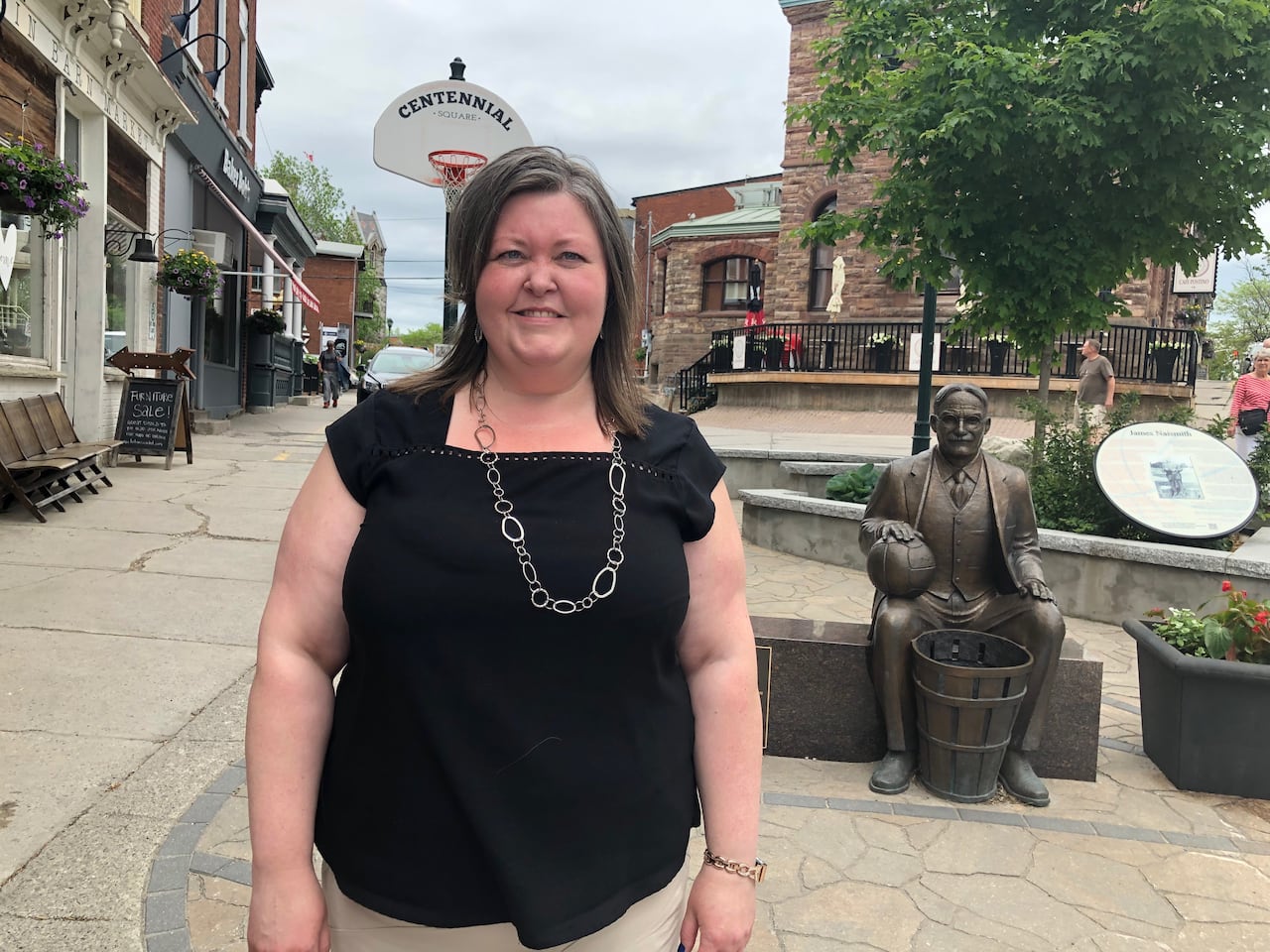
Almost half of Ontario municipalities do not impose development fees, according to Mississippi Mills Mayor Christa Lowry, chair of the Rural Ontario Municipalities Association. (Chris Rands/CBC)
Tariff uncertainty a factor
McCarthy indicated that this funding initiative aims to bolster local economies amidst the unpredictable economic climate influenced by U.S. tariffs.
He stated at the Sunday press conference that one of the primary obstacles to new housing projects is the expense related to building and enhancing infrastructure.
“Many municipalities are facing backlogs in repairs, rising construction costs, and limited financial resources for essential infrastructure initiatives—particularly if they do not charge for development,” he remarked.
Robin Jones, the outgoing president of AMO and mayor of Westport, Ontario, also praised the initiative, highlighting that infrastructure challenges can be especially daunting for rural, smaller, and northern communities.
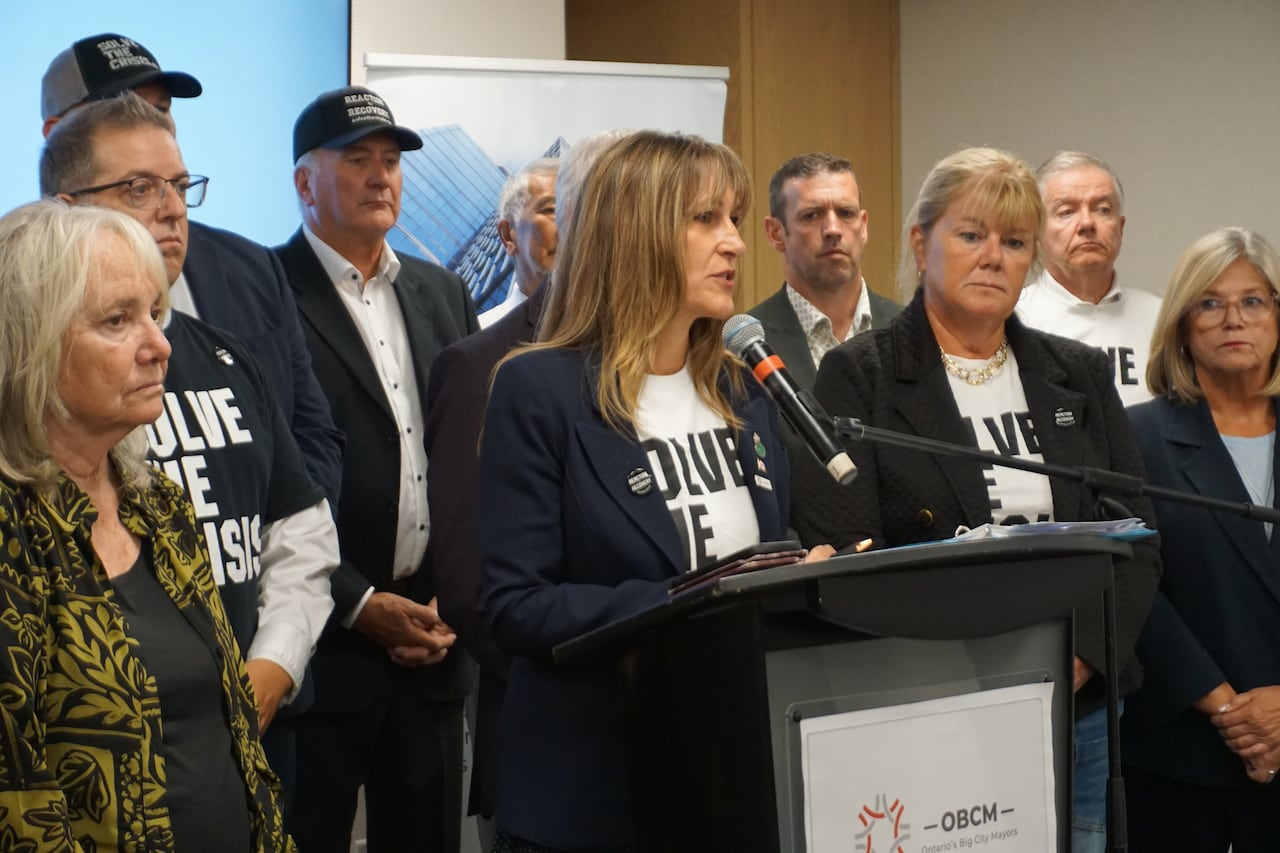
Marianne Meed Ward, the mayor of Burlington, Ont., and chair of the Ontario Big City Mayors group, addresses attendees on the opening day of the AMO conference in Ottawa. (Nathan Fung/CBC)
Call for action on addictions
Later on Sunday, the Ontario Big City Mayors (OBCM) group reiterated a concern previously voiced at past conferences: the province must take more decisive measures to address the homelessness and addiction crisis.
The group’s proposals include establishing a ministry specifically focused on addiction issues, expanding treatment options, reviewing the Health Care Consent Act and the Mental Health Act, and ultimately declaring a state of emergency.
“We need to … be bold enough to acknowledge that our current strategies are ineffective,” stated Burlington Mayor Marianne Meed Ward, who chairs the group.
“We must explore every avenue and discuss every possible solution.”
Meed Ward mentioned that she would be meeting with provincial representatives throughout the AMO conference, which is scheduled to continue until Wednesday in Ottawa.
Ontario Premier Doug Ford is expected to address the conference on Monday morning.