

A report from a U.S. government oversight agency has been published, detailing the ramifications of the conflict with Iran. It highlights deficiencies in the military’s advanced weaponry and provides the first detailed assessment of the destruction inflicted on American aircraft, military installations, and diplomatic missions in the Middle East.
The Pentagon inspector general’s document, released on Monday, presents the most comprehensive official evaluation to date regarding the toll of the conflict in terms of American lives, taxpayer expenses, and physical damage stemming from Operation Epic Fury, which has been estimated to cost $33.4 billion as of June 29. Secretary of War Pete Hegseth reported to Congress in late July that the expenses have reached $37.5 billion so far.
The report indicated that the U.S. engagement with Iran “has led to strategic inventory deficiencies and exposed industrial base constraints for munitions replenishment” concerning advanced weapon systems. Analysts have previously stated that it may take approximately three years for military suppliers to restore advanced missile and interceptor stocks to pre-conflict levels.
The Pentagon has consistently refuted claims of any munitions shortages, asserting that the U.S. military possesses sufficient arms to engage in any conflict. U.S. President Donald Trump stated in a social media update on Monday that the nation is “manufacturing more sophisticated and elite weaponry than at any point in our history.”

U.S. President Trump dismissed claims of a military munitions shortage due to the Iranian conflict, asserting that those who leaked such information to the media will be ‘hunted down’ and face ‘long-term imprisonment.’
Numerous U.S. bases and diplomatic sites targeted
The oversight report, covering the period from April 1 to June 30, confirmed that strikes from Iran caused substantial damage to hundreds of buildings and facilities at U.S. bases located in Kuwait, Bahrain, Qatar, the United Arab Emirates, Saudi Arabia, Iraq, Oman, and Jordan.
It highlighted that the U.S. naval base in Bahrain, which serves as a logistical center for the Navy in the region, was hit by Iranian drones and ballistic missiles. Consequently, the U.S. Central Command was forced to reroute supply lines to alternative hubs that were significantly farther away, such as Diego Garcia, a U.S.-U.K. base situated on an island in the Indian Ocean.
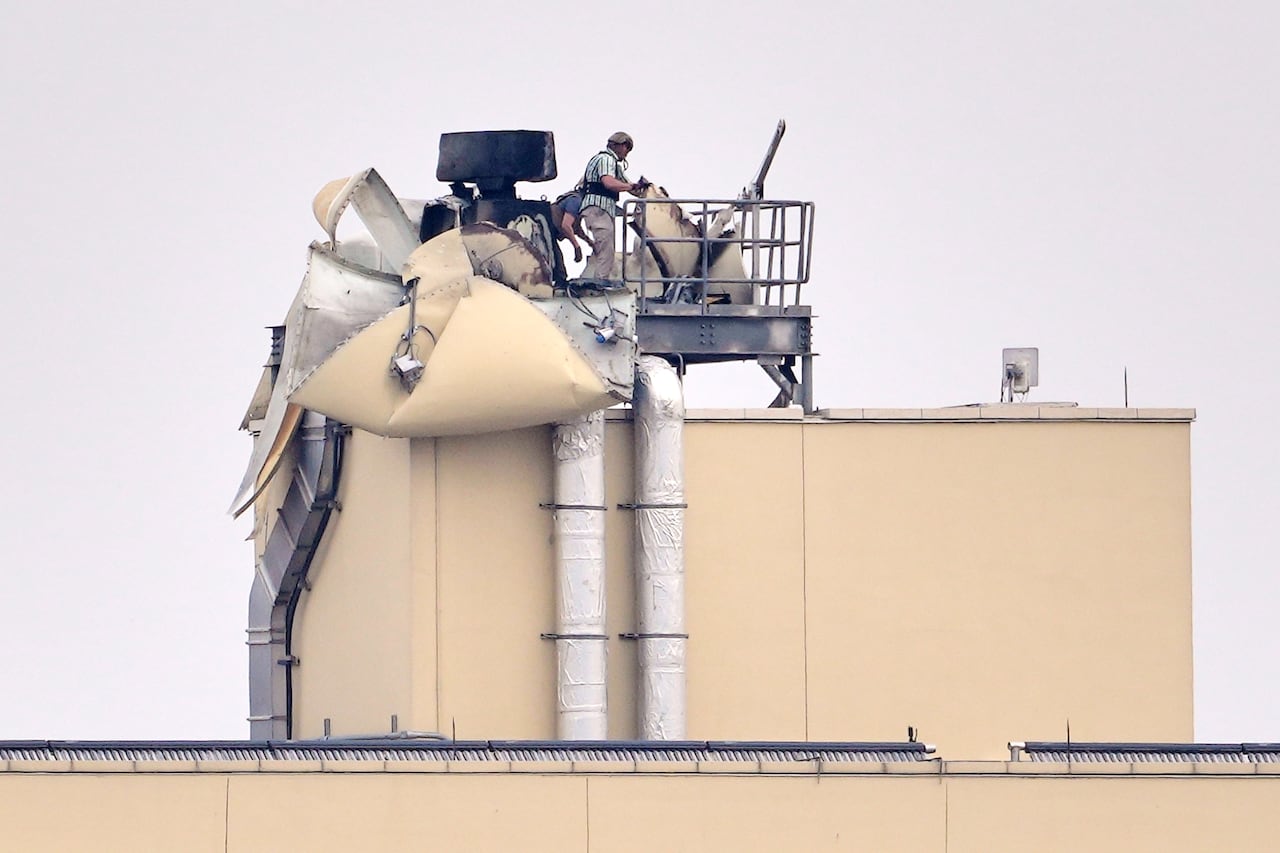
U.S. Embassy staff assess the damage caused by a bombing in Baghdad on March 14. (Hadi Mizban/The Associated Press)
Hung Cao, the acting U.S. Navy Secretary, acknowledged in a recent interview with The Epoch Times that “they blew the hell out of Bahrain” and mentioned that he is overseeing a task force evaluating whether repairs to the base in Bahrain will be necessary to maintain naval operations in the area.
The report from Monday also incorporated findings from the watchdogs associated with the Defense and State departments, as well as the U.S. Agency for International Development (USAID).
American diplomatic facilities in Kuwait, Saudi Arabia, the United Arab Emirates, and Iraq sustained physical damage from Iran’s strikes, amounting to a cost of $184 million. Moreover, the war has caused delays in construction projects at various other U.S. outposts across several nations, including Israel, Egypt, and Oman.
The State Department disclosed in early June that its additional expenses related to the conflict reached $113 million, with nearly $80 million allocated to contingency plans, including evacuation costs for U.S. personnel and their families, along with other American citizens and eligible nationals from third countries.
-
Who are the Houthis? How they could send oil prices surging even further
-
Diesel prices soar. Here are the potential impacts
The State Department noted that in the weeks and months following the initial U.S. and Israeli strikes on Iran on February 28, the Trump administration facilitated the evacuation of approximately 9,000 U.S. citizens from various countries in the Middle East and Europe. The cost of this evacuation mission, which involved private and commercial flights as well as land and sea travel, exceeded $11 million as of late June.
The majority of evacuations occurred in Israel, with Iraq and Jordan following closely. While only 1,200 Americans were evacuated from the United Arab Emirates, those flights to Istanbul, Athens, and Washington incurred the highest costs, totaling over $4 million.
Shortages in weaponry and arms sales
Numerous American aircraft and drones were also lost or damaged as a result of Iranian actions, including the destruction of approximately 30 MQ-9 Reaper drones, each valued at around $30 million. The report noted that seven KC-135 refueling aircraft were either damaged or destroyed, with five being hit by Iranian munitions while stationed on the ground in Saudi Arabia.
Additionally, another KC-135 crashed in Iraq, leading to the deaths of six service members after colliding with a different KC-135. These fatalities, along with the death of a helicopter pilot whose aircraft went down in the Arabian Sea, are categorized as occurring during non-hostile incidents. Eleven other service members are reported as “killed in action” across Kuwait, Iraq, Jordan, and Saudi Arabia.
The State Department reported that during this period, over $44 billion in both emergency and non-emergency military sales were executed, with a significant portion directed towards Saudi Arabia. These sales encompassed military helicopters, munitions, logistical support, and advanced precision weapon systems.
Additional countries in the region, including Qatar, Kuwait, the U.A.E., and Israel, also received billions in military sales, as Iran retaliated against nearly every nation that hosted a U.S. military installation.
Tag: rewrite-pending