

As Members of Parliament prepare to reconvene in Ottawa on Monday, the federal Conservative Party finds itself as an Opposition striving to gain traction in a national discourse overshadowed by U.S. President Donald Trump’s trade conflict with Canada, alongside a public increasingly focused on Prime Minister Mark Carney’s interactions with the White House.
During a press conference ahead of his caucus meeting in Penticton, B.C., the leader of the Official Opposition hinted at the party’s potential direction.
“The promise of Canada—that hard work leads to a fulfilling life, home ownership, affordable food, and safe neighborhoods—has been shattered after 11 years of Liberal leadership,” Pierre Poilievre asserted in Vancouver on Tuesday.
His remarks emphasized the theme of affordability, which proved effective when Carney’s predecessor, Justin Trudeau, held the Prime Minister’s Office.
However, pollster David Coletto indicates that Canadians are currently reluctant to attribute the blame for soaring prices to Carney.
“It’s not a direct blame on Ottawa or Mr. Carney. It’s Donald Trump,” noted Coletto, CEO of Abacus Data.
Recently, Poilievre has demonstrated an increased awareness of the significant attention Trump still commands among Canadians.
He made a trip to New York, where he appeared on Fox Business and CNBC.

Conservative Leader Pierre Poilievre appeared on CNBC’s Squawk Box telling Americans he won’t ‘attack his prime minister on foreign soil’ amid the ongoing trade war. Poilievre said Canadians are feeling ‘wounded’ and ‘confused’ over how Canada and its economy became a key target for U.S. President Donald Trump.
Acknowledging the challenge is one aspect; devising a solution is another.
“How do you establish relevance when most Canadians perceive the greatest threat to their lives as originating from the United States, and they largely believe that the prime minister and the Liberal Party are better equipped to manage it?” Coletto remarked.
Coletto, who monitored the Conservatives’ previous surge in public support before it dwindled during the 2025 federal election campaign, noted that the Official Opposition is now experiencing its lowest approval ratings in nearly ten years, with the Liberals leading by 14 points.
“I think it’s fundamentally about finding a way to manage the differing voices within your party who are opposed to being on Team Canada and who are uncomfortable with certain Liberal policies,” he explained.
‘Difficult’ conversations welcome: Conservative MP
Just last week, party insiders expressed surprise when one of Poilievre’s MPs, Jamil Jivani, advocated for a notably non-confrontational stance in engaging with the U.S.
“In our current climate, Canadians who oppose Liberal policies are being labeled and branded as traitors, while those who should be presenting an alternative to the Liberals are instead attempting to appease those in power,” Jivani stated in a video shared on his social media, set against a backdrop of the Canadian flag.
Having previously shared a university dorm with U.S. Vice-President JD Vance, Jivani likened the Liberal government’s approach to the trade dispute to their largely unchallenged management of the COVID-19 crisis, while calling for improved relations with the United States.
“We need you to remain resolute and resist the pressure to conform to a singular solution for our country’s challenges,” he urged.
While he did not directly mention Poilievre, the implication was clear enough for Dimitri Soudas, who served as spokesperson for former Conservative Prime Minister Stephen Harper.
“Not a single word criticizing Donald Trump, nor any praise for Pierre Poilievre. Sometimes, what a politician refrains from saying carries more weight than anything else,” Soudas remarked on X.
Former Alberta Premier Jason Kenney, who was part of Harper’s cabinet alongside Poilievre, shared a similar perspective.
-
Stephen Harper says Canada had ‘no choice’ but to walk away from U.S. trade talks
-
Poilievre says he’ll campaign to keep Alberta in the ‘Canadian family’ as a referendum looms
-
Federal Tories launch ‘Conservatives for Canada’ campaign ahead of Alberta referendum
“[Jivani] attempts to undermine Pierre’s significant trip by posting a self-indulgent video portraying himself as a martyr, without a kind word regarding his leader’s efforts,” Kenney commented on X.
If there is a strategy to address Jivani’s stance, Poilievre did not disclose it on Tuesday.
“We embrace a variety of perspectives from across the nation,” stated the party’s industry critic, Adam Chambers, in an interview with CBC News ahead of the caucus meeting.
“If a party is not engaging in challenging discussions, then I don’t believe they are having the necessary dialogue.”
Coletto pointed out that “not reining in [Jivani] is a way to navigate the diversity and complexity” of the Conservative coalition. However, he also indicated that it reflects “the quandary Mr. Poilievre faces regarding the Trump issue in Canada.”
Further complicating matters, Harper, who had supported both Poilievre’s leadership bid in 2022 and election campaign last year, was in Toronto to conclude the investment summit hosted by Carney.
Harper acknowledged that it “had to be a very tough choice” for Carney to step away from trade negotiations with the U.S., but expressed his belief that there was no alternative. He also praised the federal government for expediting major project approvals and expressed his optimism regarding its efforts to reduce dependency on the U.S.
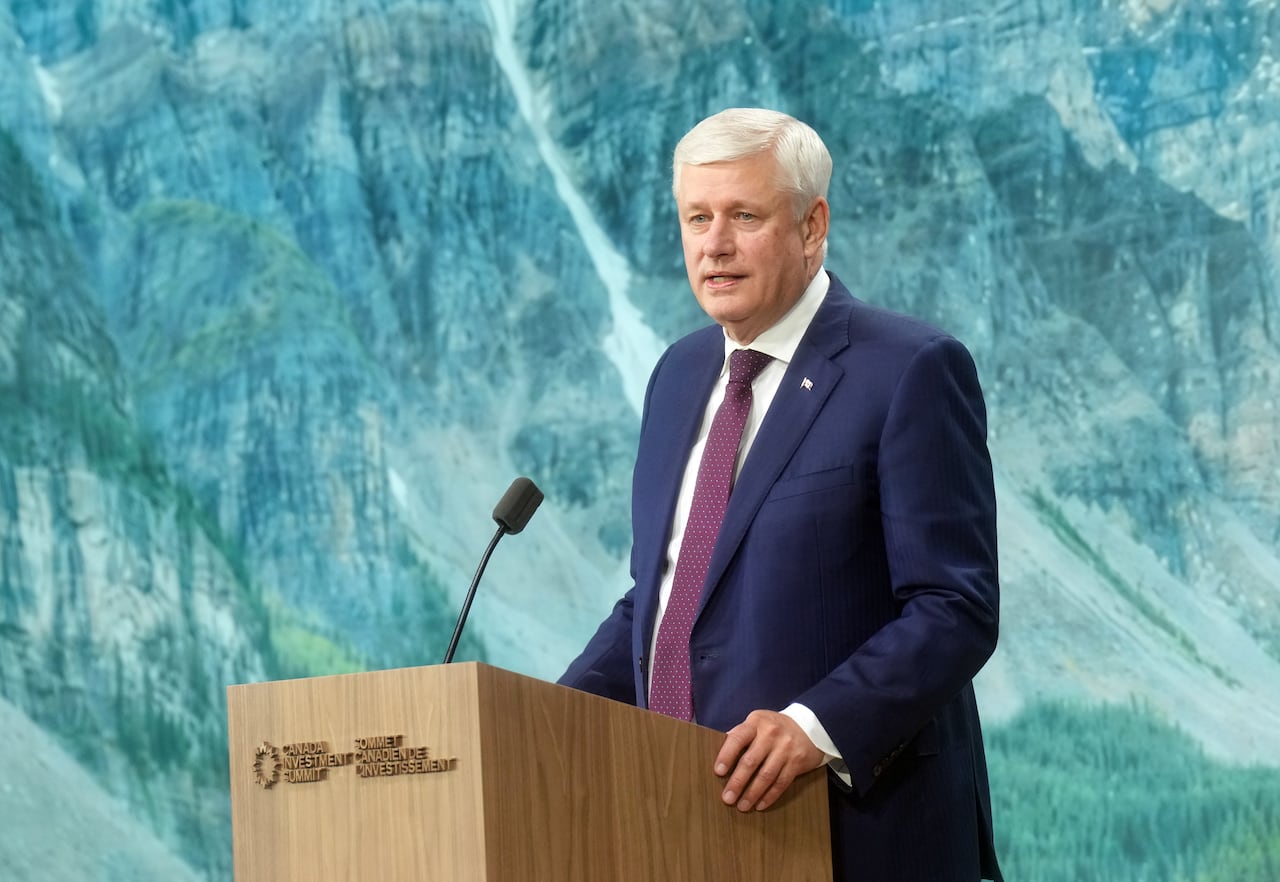
Stephen Harper, the last federal Conservative leader to form government, spoke at Prime Minister Mark Carney’s investment summit on Tuesday. (Nathan Denette/The Canadian Press)
When asked whether having the only modern Conservative prime minister present at Carney’s event undermined his message, Poilievre responded, “it does not,” adding that he had spoken with his party’s former leader a few days earlier.
“Certainly, Conservatives are always prepared to prioritize Canada, and we will collaborate with anyone,” he stated.
However, as additional challenges arise for the movement, there are uncertainties about who will support him.
Separation vote ahead
In British Columbia, the provincial Conservatives have been losing MLAs, reminiscent of the federal MPs who have departed from Poilievre’s ranks over the past year.
Additionally, a referendum in Alberta is approaching in just over a month, where voters will decide whether to remain part of Canada or consider a future ballot on secession.
In contrast to Carney, Poilievre has delivered two significant speeches in Alberta advocating for unity. However, unlike Carney, he must consider establishing a power base for his party in the province. According to Coletto’s polling, nearly 50% of Conservative voters in Alberta are sympathetic to the separatist sentiment.
“If he aspires to be prime minister of Canada, he cannot be perceived as a separatist,” Coletto emphasized.
Poilievre’s counterpart at the provincial level, Alberta Premier Danielle Smith, may have already experienced the repercussions of voters perceiving a political party as too aligned with the sovereignty movement—resulting in the Alberta NDP winning a seat in a traditionally conservative Calgary riding during a recent byelection .
This serves as yet another challenge for Poilievre’s coalition in a fall session where the agenda is increasingly threatening to overshadow his party.