

Early on Sunday, an Iranian cargo ship was hit near Qeshm Island in the Strait of Hormuz, according to Iranian state media. Consequently, Tehran’s plan to update neighboring nations regarding its controversial shipping management efforts in the strait has been delayed.
The assault, which reportedly resulted in one death and four injuries, has refocused attention on the strait, especially after escalating threats to maritime activities in the area last week, following the capture of an island by Iran-aligned Houthi rebels in the Bab al-Mandab Strait in the Red Sea.
The state-run IRNA news agency cited the governor of Qeshm blaming a “terrorist enemy” for the attack on Sunday. The U.S. military has not yet issued any immediate statements; it has previously targeted Iranian-flagged vessels amidst a blockade of Iranian ports and now faces fresh threats from Iranian ballistic missiles aimed at its warships.
Qeshm Island, located approximately 22 kilometers from Bandar Abbas, is vital for Iran to assert its authority over the Strait of Hormuz.
In the hours leading up to the incident, Iran’s government maintained a defiant stance.
“Our people cannot be intimidated into submission. Iran will not capitulate,” President Masoud Pezeshkian stated in a post on social media.
U.S. Central Command claims it launched new strikes on Iran in retaliation for the country allegedly preparing to deploy sea mines from rockets into the Strait of Hormuz. Andrew Chang explores Iran’s potential capacity to use missiles for underwater mine deployment.
(Photo credits: The Canadian Press, CAT-UXO, Reuters, Adobe Stock and Getty Images)
U.S. President Donald Trump voiced a different viewpoint, asserting on Sunday that Iran is eager to negotiate, stating that “they’re calling constantly.” Trump made this remark while at his golf course in Doonbeg, Ireland, where he was participating in a tournament.
When a reporter inquired whether the U.S. was responsible for the attack on the Iranian cargo vessel early Sunday in the Strait of Hormuz, Trump replied, “I don’t want to say.” He then boarded Air Force One to return to Washington.
Iran seeks to inform region about strait
Iran had announced that foreign ministers from regional nations would convene on Monday in Oman to discuss collaborative shipping management efforts by Iran and Oman, which is situated on the opposite side of the strait. However, the foreign minister of Oman, Badr Albusaidi, stated on X late Sunday that the meeting has been postponed “to ensure consensus.”
Mohammad Ali Bak, an official from Iran’s Foreign Ministry, mentioned that Iran and Oman mutually decided to delay the discussions “at the request of several regional countries,” as reported by IRNA on X.
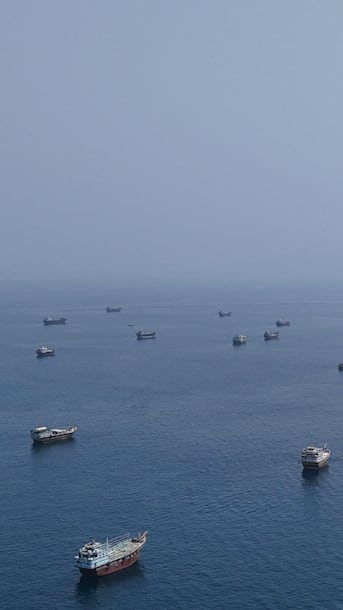
Commercial shipping activity in the Strait of Hormuz remains minimal as assaults persist on what was previously considered an international waterway prior to the outbreak of the war that began on February 28.
The United Kingdom Maritime Trade Operations reported on Sunday that a vessel was impacted by a projectile while navigating through the strait, but it was unclear whether this incident was related to the attack reported by Iran near Qeshm. The monitoring body noted that a significant fire erupted and that local authorities were in the process of evacuating those on board.
The U.S. has asserted that oil continues to exit the region as its military assists in guiding vessels along Oman’s coastline, albeit with the risk of being targeted.
Prior to the postponement of the meeting in Oman, only Iraq had publicly confirmed its intention to attend, while Bahrain announced it would not participate due to the absence of diplomatic relations with Tehran.
Since the onset of the war, Iran has shown interest in imposing fees for maritime passage. It has indicated that maritime traffic entering the Persian Gulf would traverse Iranian waters, while the outbound route would partially follow Iranian waters and partially Oman’s.
There had been some hopeful sentiments in the region regarding the scheduled meeting, as there was an anticipation that Gulf states might utilize it to present a united front against a conflict they did not instigate. For months, these nations have been targeted by Iranian attacks, which Tehran has claimed are directed at U.S. military assets on their territory.
On Sunday, Iran’s president mentioned that he had a “productive discussion” over the weekend with a senior official from the United Arab Emirates while they both attended a global summit of prominent developing nations.
Iran has launched thousands of missiles and drones against the Gulf nation, a close ally of the U.S.
Pezeshkian revealed that he had met with Abu Dhabi’s crown prince, Sheikh Khaled bin Mohamed bin Zayed, during the BRICs summit in New Delhi.
“We discussed the pressing issues to facilitate moving past previous conflicts, focusing on the future and how we can collaborate for our shared future,” Pezeshkian stated. His remarks were broadcast live on Iranian state television.