

A fresh wave of U.S. tariffs on Canadian merchandise went into effect shortly after midnight on Tuesday, imposing 50 percent duties on 110 items, which include certain cheeses, motorboats, all-terrain vehicles (ATVs), and various types of furniture.
These new tariffs are part of a series of adjustments revealed by the Trump administration last week. The updated tariff list now includes aluminum goods, wood and paper products, iron and steel beams, electric lamps, and mattresses.
The White House stated that it would concurrently lift tariffs on ten items, including salt, sugar, cement, switchboards, and toilet paper, aiming to “mitigate the impact on U.S. commerce while serving the public interest more effectively.”
In 2024, Canada sent approximately $328 million U.S. worth of toilet paper to the U.S., positioning it as the largest international supplier of this product to the country.
Canada is also a major supplier of salt to the U.S., with imports valued at around $159.2 million U.S. in 2025, according to trade data from UN Comtrade and the World Bank.
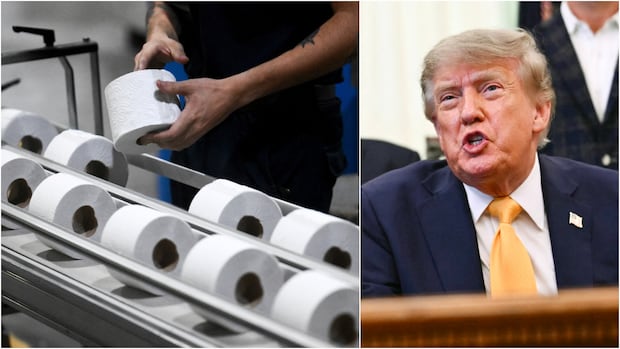
U.S. President Donald Trump removed tariffs on specific Canadian items, including toilet paper, cement, and salt. In 2024, Canada exported around $328 million worth of the product, making it the leading international supplier of toilet paper to the U.S.
According to experts, the changes in tariffs nearly balance out in economic terms, effectively negating each other.
“In terms of dollar amounts, they are effectively equivalent,” stated Wolfgang Alschner, the Hyman Soloway chair in business and trade law at the University of Ottawa, in a conversation with CBC News.
The categories from which tariffs were lifted account for roughly $2.41 billion, while the newly imposed tariffs encompass around $2.56 billion of trade in 2025, based on Alschner’s analysis. This results in only a marginal increase in tariff application, affecting a small proportion of the trade between the two nations.
The highest dollar value is found in the category of switchgear assemblies and switchboards, with the U.S. importing approximately $750 million U.S. worth of these from Canada in 2025, which are utilized in various applications from automobiles to aircraft, Alschner elaborated.
‘You need to salt your roads’
The choice to eliminate certain tariffs indicates that the U.S. is mindful of which expenses are transferred to American consumers and is ready to adjust in order to alleviate economic strain, Alschner noted.
“Salt is essential for treating roads during winter. Thus, it’s not easily replaceable,” he remarked. “The same goes for cement.”
-
What will Trump’s retaliatory tariffs do to Canada’s economy big picture? Not that much, economists predict
-
Analysis
Trade ‘war’ or not, are Canada and the United States now dug in?
These new tariffs come on the heels of the U.S. and Canada not reaching a trade agreement in August, escalating an ongoing trade conflict.
On August 22, the U.S. enacted its threat of imposing 50 percent tariffs on a broad range of Canadian products. In response, Canada introduced its own tariffs on nearly 700 types of U.S. goods, which took effect on September 8.

U.S. President Donald Trump has imposed a new set of trade measures on Canada, intensifying the trade war. CBC’s Peter Armstrong explains that the expanded scope of the trade conflict could result in regional disruptions, job losses, and the closure of small businesses.
Alongside the new tariffs announced on September 15, President Trump also revealed an impending import ban on Canadian products including alcohol, motorcycles, and a few other categories. This ban is set to be implemented on September 29.
Experts caution that the widening trade conflict may lead to regional disruptions, potentially resulting in job losses and the closure of small businesses.
According to Alschner, the new tariffs may hinder some Canadian businesses from adapting. For instance, an aluminum manufacturer might have adjusted production towards aluminum types that were not previously subjected to tariffs.
However, with these newly specified tariffs, “some of those avenues for adjustment have been restricted.”
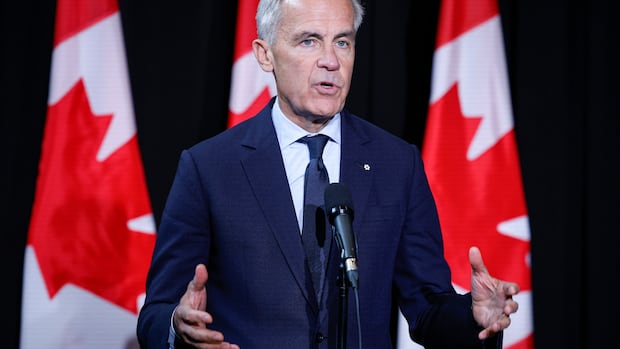
Prime Minister Mark Carney stated on Thursday that the government is monitoring U.S. President Donald Trump’s recent actions, which include bans on Canadian imports such as most alcohol products and new 50 percent tariffs on various other items. ‘We fully recognize that for individual companies and in individual sectors these are significant, and there’s a response there,’ Carney noted.
Economist Andrew Dicapua shared with CBC News that the subdued response from the U.S. to Canada’s counter-tariffs, along with the extended timeline before the import bans take effect, might indicate a potential for negotiation.
Trump recently suggested that a trade agreement with Canada could materialize “fairly soon” during a meeting with Irish Prime Minister Micheál Martin in Dublin over the weekend, Dicapua remarked.
-
Carney warns of tough times ahead in video message as retaliatory tariffs kick in
-
What tariffs are still in place? Tracking the Canada-U.S. trade war
“The timing of these bans, coming after the tariffs, should suggest that the U.S. is allowing room for negotiation,” Dicapua asserted.
“Ultimately, it is crucial that we reach an agreement with the United States as swiftly as possible. This retaliatory strategy, while well-meaning, is not a sustainable approach.”
Tag: rewrite-pending