

Prime Minister Mark Carney has announced that his administration will invite private investment into Canada’s four largest airports while ensuring that the federal government retains ownership of the land on which these airports are situated.
Carney explained that funding would be sought via “long-term concessions” for the management of these airports, which include Toronto Pearson International Airport, Vancouver International Airport, Montreal’s Trudeau International Airport, and Calgary International Airport.
“The Canadian government will keep ownership of the essential land and assets, but we aim to realize their full potential by attracting new capital and expertise to enhance their operations and growth,” Carney stated during his speech at the Canada Investment Summit in Toronto on Tuesday morning.
“We plan to reinvest the tens of billions of dollars we raise into the infrastructure necessary for Canada’s future generations,” he added.
Carney has welcomed over 100 of the world’s leading investors to the summit, aiming to secure $1 trillion in investments for approximately 167 projects across Canada over the next five years.
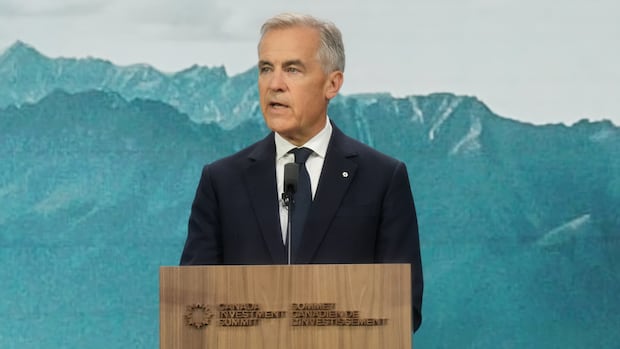
Prime Minister Mark Carney announced a plan Tuesday to seek investment to ‘unlock’ the value of Canada’s four largest airports. Carney, speaking at a major investment summit, provided few specifics but said the government would retain ownership of underlying land and assets.
During a subsequent Q&A session, Carney noted that his government examined the strategies of other nations regarding airport privatization before resolving to maintain ownership of the land.
“We benefit from being late to this discussion, as we have observed transactions that have not been successful… and we will learn from those experiences,” he remarked.
Previous administrations have considered the option of privatizing major airports, but Carney asserted that this initiative would be “different.”

Asked why the Liberal government is choosing to allow private investment in four of Canada’s largest airports now when prior governments rejected the plan, Prime Minister Mark Carney said his government is building the country in a more dangerous, divided and ‘hostile’ environment.
“We are constructing this country in a more perilous, divided world… we need to maintain fiscal responsibility,” he told reporters at a news conference following his speech.
“As we proceed, we must be judicious in our asset utilization.”
The prime minister indicated that agreements with private investors could yield “tens of billions of dollars” for public funds.
On Monday night, members of the Liberal caucus convened to discuss airport “modernization,” as reported by a federal source to Radio-Canada. This source did not specifically mention privatization. CBC News has chosen not to disclose the source’s identity as they were not authorized to speak publicly.
CTV and the Globe and Mail were the first to report that the government would announce plans regarding private investments in airports.
Lease extensions delayed, documents suggest
The government has been indicating its interest in airport privatization since the budget announcement in November. The spring economic update in May highlighted that legislation would be introduced to explore this possibility.
Currently, the federal government owns around two dozen large airports across Canada and leases the properties to non-profit airport authorities responsible for their management. According to the Canadian Airports Council, these lease payments amount to $525 million annually.
Last year’s budget also mentioned the government’s intention to extend existing ground lease agreements with airport authorities. A memo from Transport Canada, acquired by CBC News through an access to information request, indicates that the government views lease extensions as essential to “attract more private sector investment on airport lands.”
However, this memo also suggests that there has been a delay in finalizing these lease extensions. The document states that a decision to proceed with negotiations must be made by March 2026; otherwise, it could “postpone the lease extension process for several months into 2027.”
- Do you have questions about airport privatization? Send an email to ask@cbc.ca
Transport Minister Steven MacKinnon did not sign the memo until May, which was more than a month past the indicated target date.
A number of attendees include Canadian and international pension funds. Pension funds generally view airports as a stable investment, and Canadian pension funds, such as the Canada Pension Plan and Ontario Teachers’ Pension Plan, have invested in private airports abroad.
“It’s time to bring that same expertise back home to more directly benefit Canadians,” Carney stated.
The Canadian Airports Council, representing major airports in Canada, has expressed that the existing “made-in-Canada airport model has served our country very well” but is prepared to engage with the government as it progresses with this initiative.
-
‘Mega’ tax writeoffs, private money for airports: How Carney’s investment summit unfolded
-
From pipelines to railways and AI: Ottawa pitches 167 projects ahead of Carney’s investment summit
“Canada is entering a phase of significant growth, and with air travel expected to double in the next decade, our airports will be crucial in facilitating the movement of people and goods necessary for this expansion,” stated president Monette Pasher.
“If the government can unlock additional value from federal airport assets, a substantial portion of that value should remain within Canada’s airport system to help develop the infrastructure and technology that Canadians will rely on for many years to come.”
John Gradek, a lecturer in aviation management at McGill University in Montreal, remarked that allowing private investment in airports could enhance infrastructure while generating revenue for the government.
“There is a significant amount of investment required for Canadian airports because we have been slow to allocate funds,” he noted.
“Currently, the only financing options available to airport authorities are either through the bond market or via passenger fees.”
Labour congress pans privatization
Conservative Leader Pierre Poilievre expressed his desire for more details regarding Carney’s airport plan before forming an opinion.
“We want to understand how it will save money for Canadians. If it doesn’t lead to savings, then what’s the point?” Poilievre stated during a Tuesday news conference.
Conversely, the NDP criticized Carney’s proposal, asserting that “public infrastructure belongs to Canadians.”
“We will not allow Mark Carney to sell off our airports, water systems, highways, and more to the highest bidder. The future is for the many, not for the wealthy,” the party declared in a statement on X.

Trudeau International Airport in Montreal is one of the four airports that will be open to private investment. (Christinne Muschi/The Canadian Press)
On Tuesday, the Canadian Labour Congress issued a statement urging the government to reconsider the proposal allowing investors to manage airports.
“The government is citing Australia as a model, but we’ve already witnessed the outcomes: increased costs for passengers and airlines, pressure on workers, and greater airport revenue being directed to private investors,” spokesperson Lily Chang wrote in the statement.
“Amid a trade war, transferring profitable public infrastructure to private investors is precisely the wrong direction to take.”
Rod Sims, former chair of the Australian Competition and Consumer Commission, previously told CBC News that if airports are privatized, they should be accompanied by stricter regulations, such as capping airport fees.
Sims’ recommendations stem from Australia’s experiences with airport privatization in the early 2000s. He noted that airports in vast countries reliant on air travel, like Canada and Australia, function as near monopolies if there are no reasonable, nearby flight alternatives.
“I can’t provide a definitive opinion on whether privatization is suitable for Canada, but it should be approached with caution,” he said in a May interview.